


The White House can spin the economy however it wants.
The American people are keeping receipts.
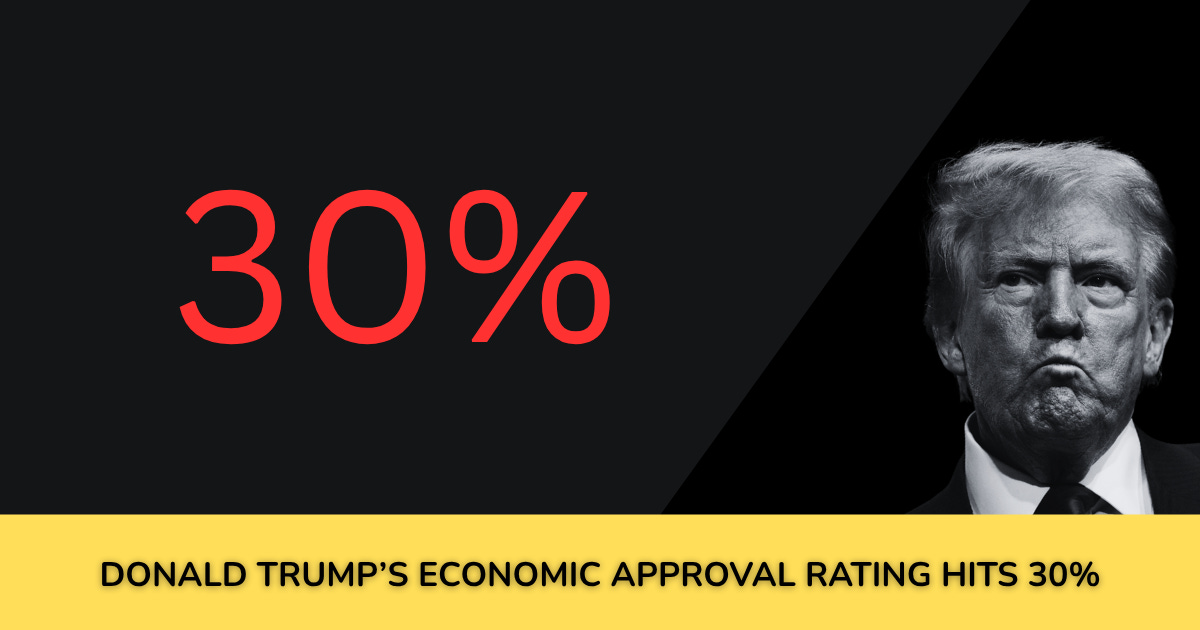
A new AP-NORC poll released April 21st finds that only 30 percent of U.S. adults approve of President Trump’s handling of the economy — down from 38 percent in March. That 8-point drop in a single month is not a rounding error. It is a political earthquake. And according to AP-NORC, it marks the lowest economic approval rating Trump has recorded in either his first or second term.
That number alone should dominate every news cycle. But buried inside the poll is a figure that tells an even more consequential story:
Republican approval of Trump’s economic management has dropped from 79 percent in February to 63 percent in late April.
Sixteen points. In roughly ten weeks. Among his own voters.
That is the story. Not the 30 percent — though 30 percent is brutal. The story is what is happening inside the Republican coalition, and why it is happening now.
The Iran War Is Doing What Tariffs Couldn’t — Yet
For months, the economic case against Trump’s second-term agenda was largely abstract to ordinary Americans. Tariff debates played out in quarterly earnings calls and supply chain spreadsheets. Prices crept up, but gradually enough that attribution was murky.
The war in Iran ended that ambiguity.
Since the U.S. entered the conflict on February 28, 2026, gas prices have risen roughly 50 percent nationally, according to AP reporting from May 5th. As of mid-May, the national average for a gallon of regular gasoline sits around $4.48–$4.55, up sharply from pre-war levels. The Institute on Taxation and Economic Policy estimates that as of May 20th, the average American household has already paid approximately $297 more for gasoline and diesel than they would have without the war. Brown University’s Costs of War project puts that figure at over $300 per household. By summer’s end, ITEP projects the additional household burden could reach $870.
Gas prices are the most visible, most democratic price signal in the American economy. Everyone fills a tank. No one can be told the number on the pump is misinformation.
The EIA’s May Short-Term Energy Outlook projects the average retail gas price will be $3.88 for all of 2026 — a figure that, at current trajectory, may already be optimistic. Oil prices have surged above $113 per barrel following disruptions tied to the Strait of Hormuz, according to Michigan’s state energy appraisal released this week.
“Wrong Track” Hits 72 Percent
The AP-NORC poll also found that 72 percent of Americans believe the country is heading in the wrong direction. That figure is not a partisan result — it reflects a broad, cross-ideological consensus that the current moment is not working for most people.
A separate Reuters/Ipsos poll released April 28th found Trump’s overall approval had dropped to 34 percent — 2 points below his mid-April and March readings, and the lowest of his current term. A Fox News poll released in late May found Trump’s approval among Republicans at a new all-time low in that outlet’s tracking.
The trend line is not ambiguous. It is not a blip. Multiple independent polling operations — AP-NORC, Reuters/Ipsos, Fox News, the New York Times/Siena — are converging on the same conclusion: Trump’s political standing is eroding, and the erosion is accelerating.
What This Means Politically
Republican strategists would normally dismiss a drop in overall approval as a media-class obsession. They have a point — Trump won twice while underwater in national polls. But the intra-party erosion is different in kind.
When 79 percent of Republicans approved of Trump’s economic management in February, that left almost no room for a primary challenge or meaningful dissent. At 63 percent — and falling — the Republican coalition on the economy starts to look less like a fortress and more like a fault line.
The 2026 midterms are now operating in this environment. Republican incumbents in competitive districts face a choice that did not exist six months ago: embrace a president whose economic numbers are deteriorating in ways voters feel in their daily lives, or begin the uncomfortable process of creating daylight.
Neither option is comfortable. And Trump, characteristically, is not making it easier — multiple reports indicate he has dismissed soaring gas prices publicly, drawing criticism even from Democratic lawmakers who described him as “out of touch.”
Dismissing the pain of the people you govern is not a strategy. It is a liability.
The Structural Problem Beneath the Polling
The polling captures a political moment. The underlying economics suggest it may not improve quickly.
The war in Iran shows no signs of imminent resolution. Americans have already spent an estimated $39 billion more on motor fuel since the conflict began, according to ITEP. That is not money that gets refunded when a ceasefire is announced. Supply chains disrupted by tariff policy throughout 2025 remain impacted. And the Federal Reserve has limited tools to address supply-side inflation without risking recession.
The administration inherited — and in many respects engineered — an economy where the causes of cost-of-living pressure are deeply entangled with its own policy choices. Unwinding them without political cost is not a serious option on any plausible timeline before November.
What the AP-NORC poll measures, ultimately, is not just disapproval of a president. It is the moment when a sufficient share of the electorate — including the president’s own supporters — stopped believing the economic story they were being told.
That moment has arrived. The question now is what happens next.
Sources: AP-NORC Center for Public Affairs Research (April 21, 2026); AP News; Reuters/Ipsos (April 28, 2026); Institute on Taxation and Economic Policy (May 20, 2026); Brown University Costs of War Project; EIA Short-Term Energy Outlook (May 2026); WHSV/AP (May 5, 2026); The Hill; New York Times; Michigan MPSC Summer Energy Appraisal (May 2026).