


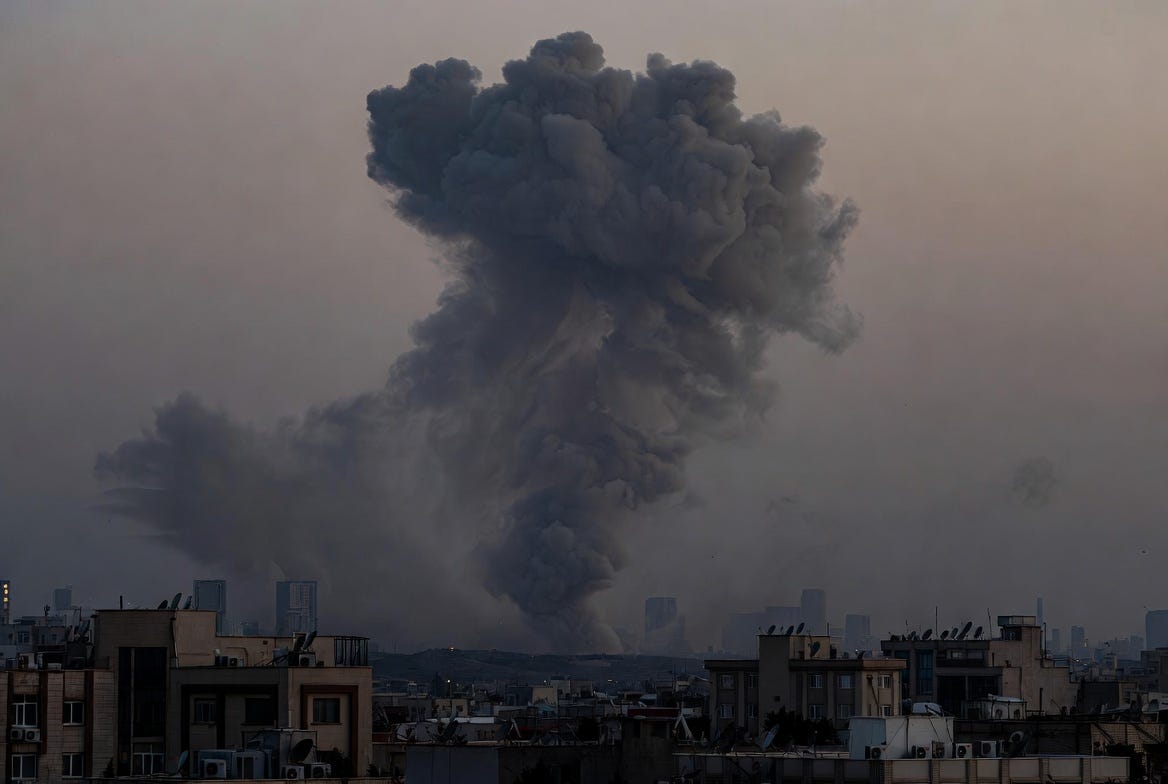
The 2026 Iran War, launched by joint U.S.-Israeli airstrikes on February 28, has entered its fourth week. U.S. and Israeli forces have targeted Iranian nuclear sites, missile factories, naval assets, and leadership, killing Supreme Leader Ali Khamenei and senior officials. Iran has retaliated with ballistic missiles, proxy attacks, and a partial closure of the Strait of Hormuz, driving up global oil prices and disrupting shipping. More than 2,300 Iranian civilians have died, along with U.S. and Israeli losses.
As the conflict rages, here are the clearest, most substantive arguments on both sides.
Arguments For the War
Proponents—primarily U.S. and Israeli officials, plus national-security analysts—contend the campaign is necessary self-defense that delivers outsized strategic gains at acceptable cost.
First, it neutralizes existential threats. Iran’s nuclear program, ballistic-missile arsenal, drone fleet, and navy have been severely degraded; dozens of naval vessels now rest on the seabed and key production sites lie in ruins. A nuclear-armed Iran would spark a regional arms race, embolden Tehran to shield its proxies, and limit U.S. freedom of action. By striking now, Washington and Jerusalem have prevented that outcome for years.
Second, the strikes dismantle Iran’s proxy empire. Hezbollah, Hamas, the Houthis, and Shia militias in Iraq have relied on Iranian weapons, funding, and command. Weakening the sponsor reduces attacks on U.S. troops (Iranian-backed groups killed over 600 Americans in Iraq alone) and stabilizes shipping lanes and Israel’s borders.
Third, the operation restores deterrence. For decades Iran faced “death to America” rhetoric, hostage-taking, and attacks on shipping while the U.S. responded with sanctions that ultimately failed. Credible military action signals that red lines—nuclear breakout, mass protests crushed by the regime—will be enforced. Supporters note that airpower has already achieved more degradation in weeks than years of diplomacy.
Finally, some frame the war in humanitarian terms: the Islamic Republic has brutalized its own citizens for 47 years. Decapitation strikes and sustained pressure could open space for internal change, even if full regime collapse is not guaranteed.
Arguments Against the War
Critics—diplomats, regional experts, and some former U.S. officials—argue the costs outweigh the gains and that airpower cannot solve Iran’s underlying problems.
The most immediate objection is escalation risk and economic blowback. Iran retains missiles and drones capable of hitting Gulf oil infrastructure and Israeli cities; the Strait of Hormuz crisis has already spiked energy prices. Further strikes could drag in proxies, spark wider regional conflict, or provoke Iranian terrorism abroad—outcomes that harm U.S. allies and the global economy far more than the limited military gains justify.
Second, regime change via bombing is a proven illusion. History shows air campaigns rarely topple entrenched regimes; they often produce a “rally-around-the-flag” effect. The Islamic Revolutionary Guard Corps (IRGC) is filling the power vacuum left by assassinated leaders and is poised to tighten control. Even if the current theocracy fractures, the likely successor is not Jeffersonian democrats but hardline military rule. Past precedents—Libya 2011, Iraq 2003—warn that power vacuums breed chaos, not freedom.
Third, the war lacks legal and strategic necessity. Critics insist there was no imminent Iranian attack on the U.S. homeland; the strikes were preemptive and therefore illegal under most readings of the UN Charter. Diplomacy and sanctions, though imperfect, had slowed Iran’s nuclear program before; military action now hardens Iranian resolve, empowers hardliners, and damages America’s global image as a rule-following power.
Finally, the human and opportunity costs are enormous. Thousands of civilians are dead, Iranian society is further securitized, and U.S. resources are diverted from higher-priority threats such as China. Many Iranians oppose both their regime and foreign bombs; the strikes may delay—not hasten—internal reform.
The Debate Continues…
The strongest case for the war rests on immediate, measurable degradation of Iran’s most dangerous capabilities.
The strongest case against rests on the near-certainty of prolonged costs, uncertain long-term outcomes, and the repeated failure of bombing campaigns to produce stable political change.
As Operation Roaring Lion continues and Tehran’s retaliation persists, the debate is no longer theoretical: every additional week of fighting will test which set of arguments better matches reality.